

There’s one thing I ask every single one of my clients to do. It’s free, it takes five minutes, and most people get it wrong.
It’s gratitude – not just journaling but exploring ALL of it’s surfaces. And before you roll your eyes and close this tab — stay with me. Because the conversation I’m about to have with you is probably not the one you’ve heard before.
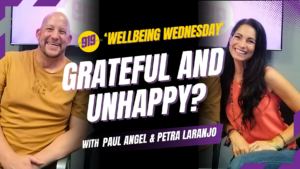 On this week’s WellBeing Wednesday on 919FM, I posed a question that I’ve been sitting with a lot lately, and that I hear in different versions from clients, friends and people who reach out:
Can you be genuinely grateful — and genuinely unhappy — at the same time?
The answer is yes. And the word that makes it possible is “And.”
The “But” problem.
Most of us have been taught a version of gratitude that sounds like this: “I’m grateful, but…” And we’ve been conditioned to believe that the “but” cancels out the gratitude. That acknowledging what’s hard somehow makes us ungrateful for what’s good.
What I’ve found, in my own life and in the work I do, is that it’s only a problem when the “but” takes over your entire perspective – when it stops being an honest acknowledgement of difficulty and becomes the lens through which you filter life. When you have a propensity for things always going wrong… that’s what needs to shift.
The invitation isn’t to replace the “but” with toxic positivity. It’s to replace it with “And.”
I’m grateful. And I am struggling right now.
I love what I’ve built. And I need it to change.
I appreciate this chapter of my life. And I’m ready for the next one.
Both are true. Neither cancels the other. That is what it means to be in allowance for being human.
Why gratitude doesn’t always feel natural.
Our biology isn’t wired for it. The human brain is designed, at a neurological level, to scan for threat i.e. what could go wrong, what to fear, what to protect against. This negativity bias kept our ancestors alive. It also keeps most of us in a low-grade state of dissatisfaction, no matter how good things actually are.
Gratitude requires conscious effort because it runs against the grain of our default operating system. It is a practice, not a personality trait. And like any practice, it gets easier the more consistently you do it. So get practicing 😉
The science: Gratitude is considered the highest-frequency emotion — not love, as most of us assume. At a physiological level, the practice of gratitude activates the parasympathetic nervous system, reduces cortisol, and over time, measurably rewires neural pathways toward a more optimistic baseline. This isn’t self-help fluff. It’s documented neuroscience.
The practice. Ten things. No less.
Here’s the exercise I give every client without exception. And I’m giving it to you now, so consider this your first session.
Find ten things you can be genuinely grateful for. TEN. Not three – not five…ten.
Here’s why the number matters:
- 1 to 3 is easy. Your brain finds the obvious ones fast.
- 4 to 5 takes genuine effort. You have to look a little harder.
- 6 to 10 is where the real work happens. Your subconscious mind is being asked to go looking for proof of goodness in your life – that’s how neural pathways get rewired. That’s the practice.
This is the minimum I ask of clients. So if we ever work together, know that this is coming.
A note on negativity.
People who perpetually live in negativity – those who consistently expect things to go wrong, who meet every situation with cynicism – tend to find that life delivers exactly what they expect – not because the universe is punishing them, but because that posture alienates the people and opportunities around them. Which creates more evidence for the story they’re already telling.
If you find yourself feeling isolated, overlooked or chronically disappointed, I want to offer this perspective: it may be worth looking at how you’re showing up – not with self-blame, but just awareness and allowance – because who you (your personality) is not fixed. You can choose, at any point, to show up differently. It may go against the personality you’ve practised for years but that doesn’t mean it’s not available to you.
You can continue being unhappy with your life or, despite whatever is going on, you can choose something different. Both are options. Only one of them compounds in your favour.
 The doggo who couldn’t say thank you.
Yesterday, on our way to the park, my girls (my fur kids) and I found ourselves in a confusing stretch of traffic along a very busy Beyers Naudé. At first it wasn’t clear what was happening, and then we saw him — a frightened dog darting across the road, disoriented and in real danger.
A huge shoutout to Aimée Baxter and CJ from SPCA Randburg, who stopped everything and safely rescued him. That sweet stray couldn’t say thank you – he was scared and confused and had no idea what was happening – but the sense of fulfilment the three of us felt and watching people who saw a vulnerable life and chose to stop, to care, and to act – was priceless.
(Check out the video on my socials FB / IG. He’ll be available for adoption within six days if no one claims him. He’s the sweetest kid.)
It’s not always about the other person being able to acknowledge you. Sometimes the fulfilment is entirely in you being true to who you are. In showing up as the person you want to be, regardless of whether anyone notices or thanks you for it.
Being appreciated for what we do is a nice thing for our ego but it’s ultimately about who you are and how you show up — because if you don’t show up authentically, you aren’t really showing up as you.
How to express gratitude to someone today.
By the end of reading this, I want to invite you to send a message to someone – just one – expressing sincere gratitude. Not just “thank you” – tell them why.
Is it something they did? Or simply how they show up in your life? Be specific. And, most importantly, sincere.
Heads up: The person you message may deflect it. They may dismiss it, redirect it, minimise it or feel uncomfortable receiving it. That is completely normal. Most of us have not been taught how to receive appreciation gracefully.
When that happens, say this: “You don’t have to say anything. I just want you to know that I’m grateful for you, because…”
Don’t give them the opportunity to not receive it. Just leave it there.
And then notice something in yourself as well — because the same is true in reverse 😉 When someone expresses sincere appreciation to you and you dismiss it, redirect it, or minimise it, you’re taking something from them. The act of receiving gracefully is its own form of generosity.
We often say it’s better to give than to receive. What if it’s both?
Gratitude is the road to happiness.
Not the destination. The road. It won’t instantly resolve what’s hard and it won’t make the difficult things disappear, but practised consistently, it changes the lens through which you experience your life — and that changes everything about what you notice, what you attract, and who you become in the process.
You can be grateful and unhappy. Both are true, and neither cancels the other. The invitation is simply to make sure that “grateful” gets as much airtime as “unhappy” does.
Gratitude isn’t the opposite of unhappiness. It’s the practice that makes unhappiness more bearable — and joy more available.
I’d love to know: what’s one thing you’re genuinely grateful for today that you haven’t said out loud yet? Leave it in the comments, or send it to someone who needs to hear it.
And if this conversation is one you want to keep having – tune in to WellBeing Wednesday on 919FM, or reach out. This is the work.
With love and appreciation,
Petra
Alignment Architect for Intentional Performance


